Kubeflow is an open-source platform for Machine Learning and MLOps on Kubernetes introduced by Google. The different stages in a typical machine learning lifecycle are represented with different software components in Kubeflow, including model development, model training, model serving, and automated machine learning.
| Tool | Description |
|---|---|
| Arena | A CLI for Kubeflow |
| Romario | RESTful API for kick-starting a KF-Pipeline |
| Training-operator | Training operators on Kubernetes |
| Katib | Repository for hyperparameter tuning |
| Fairing | Python SDK for building, training, and deploying ML models |
| KServe | Standardized Serverless ML Inference Platform on Kubernetes |
| Kale | Kubeflow’s superfood for Data Scientists |
| BentoML | Unified Model Serving Framework |
| Yatai | Model Deployment at Scale on Kubernetes |
| Bootstrap | 🪐 1-click Kubeflow using ArgoCD |
Articles/Talks
- Building a Complete AI Based Search Engine with Elasticsearch, Kubeflow and Katib
- Search system on top of Elasticsearch, Kubeflow and Katib
- An end-to-end ML pipeline on-prem - Notebooks & Kubeflow Pipelines on the new MiniKF
- Distributed TensorFlow training using Kubeflow on Amazon EKS
- Building a ML Pipeline from Scratch with Kubeflow
- Train and Serve TensorFlow Models at Scale with Kubernetes and Kubeflow on Azure
Main components
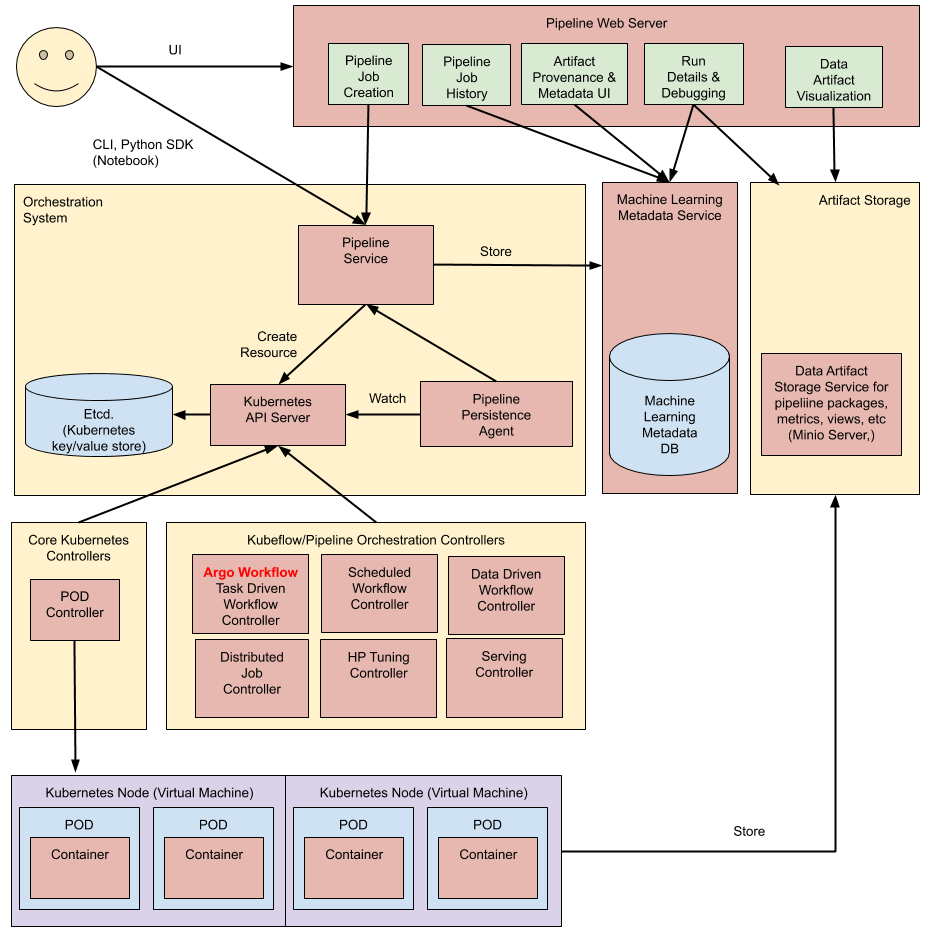
Authentication
Kubeflow use ambasador-oidc call oidc-authservice as an authentication service with an HTTP Server in combination with Dex as OIDC provider.
Centraldashboard
The Kubeflow Central Dashboard provides an authenticated web interface for Kubeflow and ecosystem components. It acts as a hub for your machine learning platform and tools by exposing the UIs of components running in the cluster. Access through the Istio Gateway that provides access to the Kubeflow.
Notebook
Kubeflow Notebooks provides a way to run web-based development environments inside your Kubernetes cluster by running them inside Pods. Support Jupyter and VSCode.
Kubeflow use these services for deploy and control notebooks:
- jupyter-web-app-deployment
- volumes-web-app-deployment
- notebook-controller-deployment
Deactivate secure cookies if TLS is not configured.
# change in kubernetes templates
APP_SECURE_COOKIES = false
Metadata
Kubeflow Pipelines backend stores runtime information of a pipeline run in Metadata store. Runtime information includes the status of a task, availability of artifacts, custom properties associated with Execution or Artifact, etc. Learn more at ML Metadatafor using google/ml-metadata.
Kubeflow use these services:
- MySQL - store metadata
- metadata-envoy-deployment - envoy proxy
- metadata-grpc-deployment - allows other components to interact with the metadata service
- metadata-writer - comprehensive record of the entire machine learning lifecycle
Pipelines
Cache
The cache server is a key-value storage system that store frequently accessed ML artifacts, such as trained models and intermediate results.
- cache-server
Admission webhook
We need a way to inject common data (env vars, volumes) to pods (e.g. notebooks). PodPreset implementation, customize it for Kubeflow and rename it to PodDefault to avoid confusion. Use admision webhook and CRD to implement the functionality.
- admission-webhook-deployment
PVCViewer
Use filebrowser for provide a file managing interface within a specified directory.
Metacontroller
Use metacontroller as an add-on for Kubernetes that makes it easy to write and deploy custom resources
Istio
KServe
- KServe - The State and Future of Cloud-Native Model Serving
- Open Inference Protocol (V2 Inference Protocol)
Add SSL
- Create certificate
kubectl create -n knative-serving secret tls custom-certs --key registry.key --cert registry.crt- Edit deployment knative-serving
apiVersion: apps/v1
kind: Deployment
metadata:
  name: controller
  namespace: knative-serving
spec:
  template:
    spec:
      containers:
        - name: controller
          volumeMounts:
            - name: custom-certs
              mountPath: /path-to-docker-registry-cert  # replace here.
          env:
            - name: SSL_CERT_FILE
              value: /path-to-docker-registry-cert # replace here.
            - name: GODEBUG
              value: x509ignoreCN=0
      volumes:
        - name: custom-certs
          secret:
            secretName: custom-certs
Other components
CLI
Use kfpfor interact with Kubeflow as and API for Python, the CLI version only works with GCP (Google Cloud Platform).
- You can perform all operations with the API