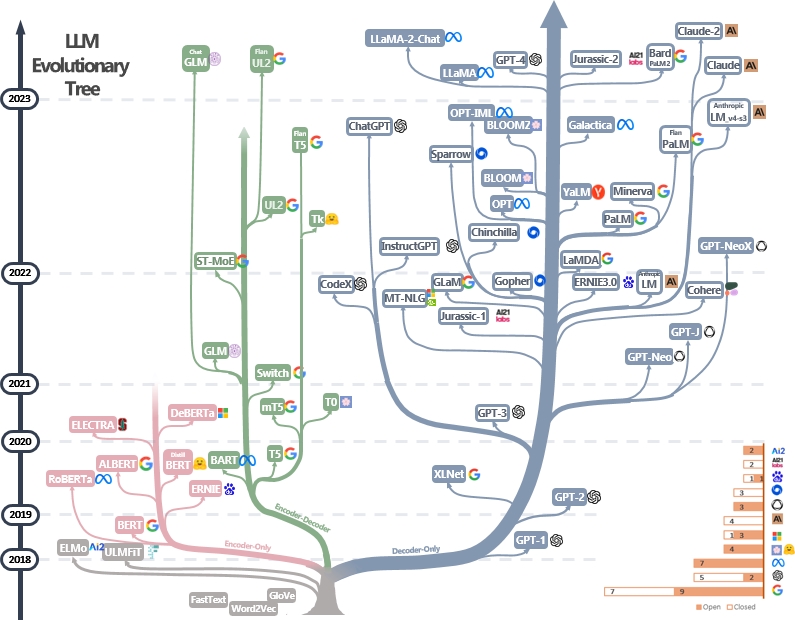
A large language model is a type of Artificial Intelligence algorithm that applies neural network techniques with lots of parameters to process and understand human languages or text using self-supervised learning techniques. Tasks like text generation, machine translation, summary writing, image generation from texts, machine coding, chat-bots, or Conversational AI are applications of the Large Language Model. Examples of such LLM models are Chat GPT by open AI, BERT (Bidirectional Encoder Representations from Transformers) by Google, etc.
| Tool | Description |
|---|---|
| Langchain | Building applications with LLMs through composability |
| Rebuff | LLM Prompt Injection Detector |
| GPTCache | Semantic cache for LLMs |
| LLMSherpa | Developer APIs to Accelerate LLM Projects |
| OpenLLM | Operating LLMs in production |
| vLLM | Easy, fast, and cheap LLM serving for everyone |
| LLaVa | LLaVA: Large Language and Vision Assistant |
| SkyPilot | Run LLMs, AI, and Batch jobs on any cloud |
| Zep | Fast, scalable building blocks for production LLM apps |
| Lanarky | Framework to deploy LLM applications in production. Built on top of FastAPI |
| Text-generation-ui | Web UI for running Large Language |
| Stable-diffusion-web | Stable Diffusion web UI |
| Argilla | The open-source data curation platform for LLMs |
| Text-generation-inference | LLM Text Generation Inference |
| Peft | PEFT: State-of-the-art Parameter-Efficient Fine-Tuning |
| Haystack | LLM orchestration framework to build customizable, production-ready LLM applications |
| FlowiseAI | Drag & drop UI to build your customized LLM flow |
| Trulens | Evaluation and Tracking for LLM Experiments |
| DocArray | Pydantic for LLM (Represent, send, store and search multimodal data) |
| Jina | Build multimodal AI applications with cloud-native stack |
| Pezzo | Open-source, developer-first LLMOps platform designed |
| VDP | Integrate AI to process unstructured data in the modern data stack |
| Leon | Open-source personal assistant |
| Dify | LLM app development platform |
| PromptFlow | Build high-quality LLM apps |
| LangFlow | Langflow is a dynamic graph where each node is an executable unit |
| ChatbotUI | AI chat for every model |
| FastChat | An open platform for training, serving, and evaluating large language models. Release repo for Vicuna and Chatbot Arena. |
| UltraChat | Large-scale, Informative, and Diverse Multi-round Chat Data |
| LiteLLM | Call all LLM APIs using the OpenAI format. (100+ LLMs) |
| AgentGPT | Assemble, configure, and deploy autonomous AI Agents in your browser |
| AutoGPT | Accessible AI for everyone, to use and to build on. |
| AutoGen | A programming framework for agentic AI |
| OpenWeb-UI | User-friendly WebUI for LLMs |
| Guidance | A guidance language for controlling LLM |
| OpenUI | Building UI components with AI |
| dsPy | The framework for programming—not prompting—foundation models |
| Semantic Kernel | Integrate cutting-edge LLM technology quickly and easily into your apps |
| LLMStack | No-code multi-agent framework to build LLM Agents |
| Vanna | Chat with your SQL database |
| Deepseek | Closed-Source Models in Code Intelligence |
| LocalAI | Open Source OpenAI alternative, Self-hosted |
| LLama-Factory | Unify Efficient Fine-Tuning |
| Lago | Metering and Usage Based Billing API, Consumption tracking |
| Lunary | The production toolkit for LLMs |
| OpenLLMetry | Open-source observability for your LLM application |
| Evidently | Evaluate and monitor ML models from validation to production |
| Promptify | Prompt Engineering and Prompt Versioning |
| Mem0 | The memory layer for Personalized AI |
| Maestro | A framework for Claude Opus to intelligently orchestrate subagents. |
| Inspect | An open-source framework for large language model evaluations |
| Anything-llm | The all-in-one Desktop & Docker AI application with full RAG |
| Gorilla | An API store for LLMs |
| CrewAI | Framework for orchestrating role-playing, autonomous AI agents. |
| MLE-agent | Your intelligent companion for seamless AI engineering and research |
| Promptfoo | Test your prompts, agents, and RAGs |
| Langwatch | The ultimate LLM Ops platform - Monitoring, Analytics, Evaluations, Datasets and Prompt Optimization |
| Langfuse | Open source LLM engineering platform: LLM Observability, metrics, evals, prompt management, playground, datasets |
| LM-course | Course to get into Large Language Models (LLMs) with roadmaps and Colab notebooks |
| Chonkie | The no-nonsense RAG chunking library |
| Crawl4ai | Crawl4AI: Open-source LLM Friendly Web Crawler & Scraper |
| Exo | Run your own AI cluster at home with everyday devices |
| Docling | Get your documents ready for gen AI |
| SuperPrompt | SuperPrompt is an attempt to engineer prompts that might help us understand AI agents |
| Scrapegraph-ai | Python scraper based on AI |
| Anything-llm | The all-in-one Desktop & Docker AI application with built-in RAG, AI agents, No-code agent builder, and more. |
| Data-formulator | Create rich visualizations with AI |
| FlashLearn | Integrate LLM in any pipeline - fit/predict pattern, JSON driven flows, and built in concurency support. |
| Pathway AI Pipelines | Ready-to-run cloud templates for RAG, AI pipelines, and enterprise search with live data. |
| pydantic-ai | Agent Framework / shim to use Pydantic with LLMs |
| lollms-webui | Lord of Large Language and Multi modal Systems Web |
| Phoenix | AI Observability & Evaluation |
| Opik | Debug, evaluate, and monitor your LLM applications, RAG systems, and agentic workflows with comprehensive tracing, automated evaluations |
| deepeval | The LLM Evaluation Framework |
| oMLX | Local LLM inference server optimized for Apple Silicon Macs with continuous batching and tiered KV caching managed via native menu bar application |
| Onyx | Open-source AI platform with RAG, web search, code execution, and custom AI agents all in a feature-rich self-hosted interface |
| Open Notebook | Privacy-focused alternative to Google Notebook LM for AI-powered research |
Articles/Talks
- The Practical Guides for Large Language Models
- A Watermark for Large Language Models
- Accelerating Large Language Models with Mixed-Precision Techniques
- Understanding the Fundamental Limitations of Vector-Based Retrieval for Building LLM-Powered Chatbots— Part 1-3
- Advancing AGI for humanity
- Evaluating Large Language Model (LLM) systems - Metrics, challenges, and best practices
- LLM-PowerHouse: A Curated Guide for Large Language Models with Custom Training and Inferencing
RAG
RAG is a technique for augmenting LLM knowledge with additional data.
Vector Database (VDB)
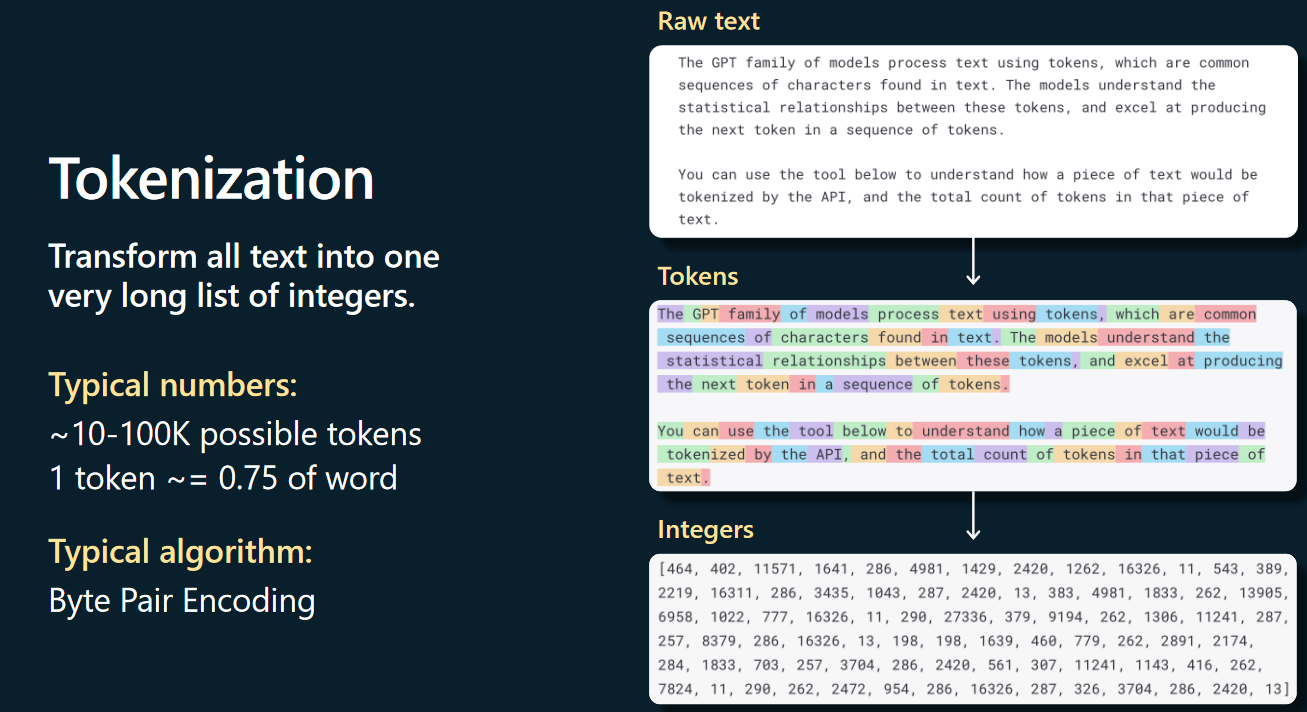
Tokenization
Best LLM
- https://blog.abacus.ai/blog/2023/08/10/create-your-custom-chatgpt-pick-the-best-llm-that-works-for-you/
- https://huggingface.co/spaces/openlifescienceai/open_medical_llm_leaderboard
- https://huggingface.co/spaces/open-llm-leaderboard/open_llm_leaderboard
- https://huggingface.co/spaces/lmsys/chatbot-arena-leaderboard
- https://huggingface.co/collections/open-llm-leaderboard/the-big-benchmarks-collection-64faca6335a7fc7d4ffe974a
Text embeddings
Text Embeddings give you the ability to turn unstructured text data into a structured form. With embeddings, you can compare two or more pieces of text, be it single words, sentences, paragraphs, or even longer documents. And since these are sets of numbers, the ways you can process and extract insights from them are limited only by your imagination.
Embeddings on Multimodal Data
- Embed text, image and video in the same semantic space with the same dimensionality.
- Create the capability for join text with image/video for classification for example.
Nearest Neighbor
Nearest neighbor search (NNS), as a form of proximity search, is the optimization problem of finding the point in a given set that is closest (or most similar) to a given point. Closeness is typically expressed in terms of a dissimilarity function: the less similar the objects, the larger the function values.
ScaNN
- More efficient for a concrete corpus
Question Answering
Models
LLama
Transformers
Fine-Tuning
RLHF
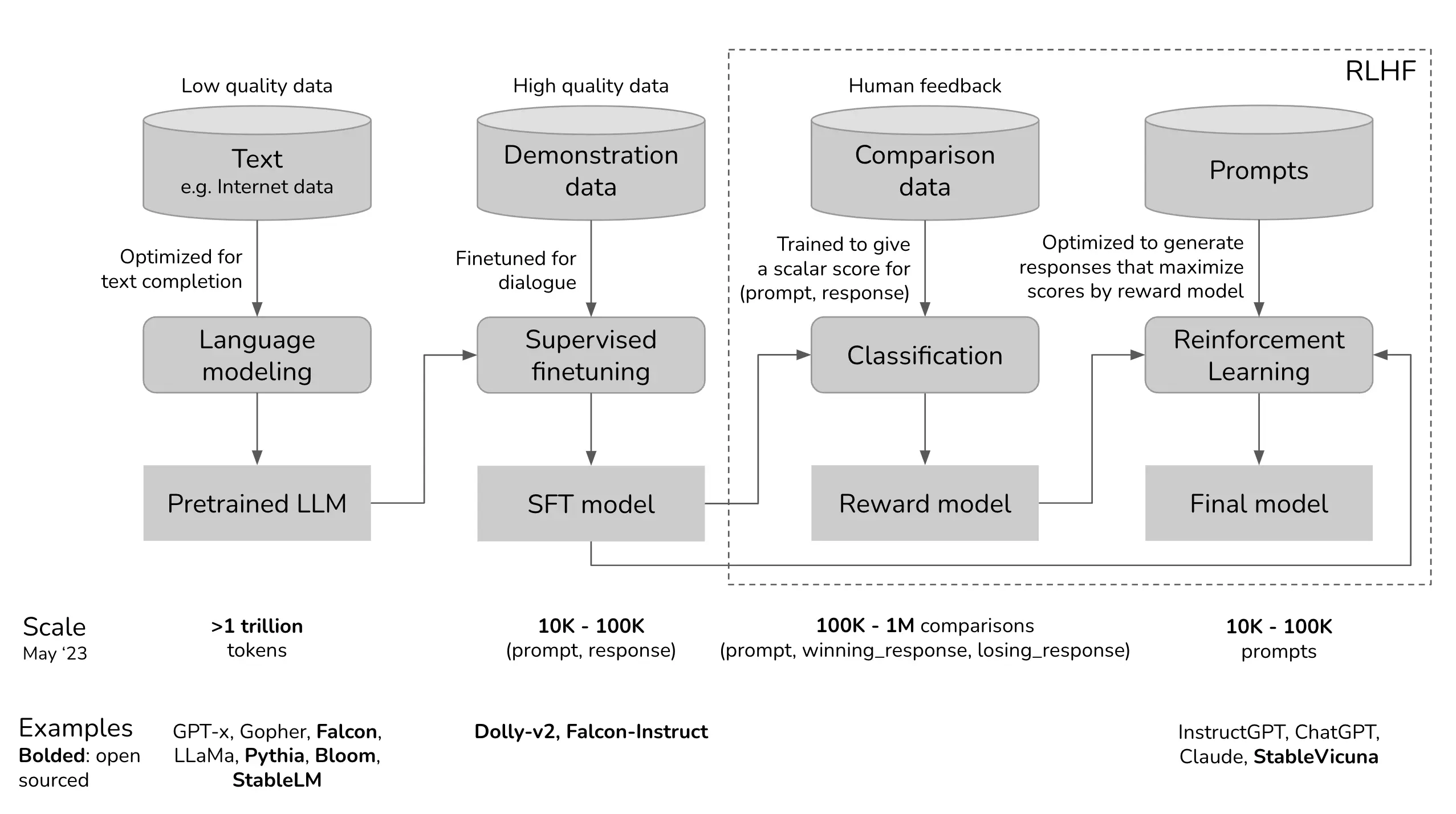
Distillation - Train a small model to mimic the behavior of a large model Adapter Tunning Full Fine Tunning
Parameters
- Frequency_penalty: This parameter is used to discourage the model from repeating the same words or phrases too frequently within the generated text. It is a value that is added to the log-probability of a token each time it occurs in the generated text. A higher frequency_penalty value will result in the model being more conservative in its use of repeated tokens.
- Presence_penalty: This parameter is used to encourage the model to include a diverse range of tokens in the generated text. It is a value that is subtracted from the log-probability of a token each time it is generated. A higher presence_penalty value will result in the model being more likely to generate tokens that have not yet been included in the generated text.
Both of these parameters can be adjusted to influence the overall quality and diversity of the generated text.